
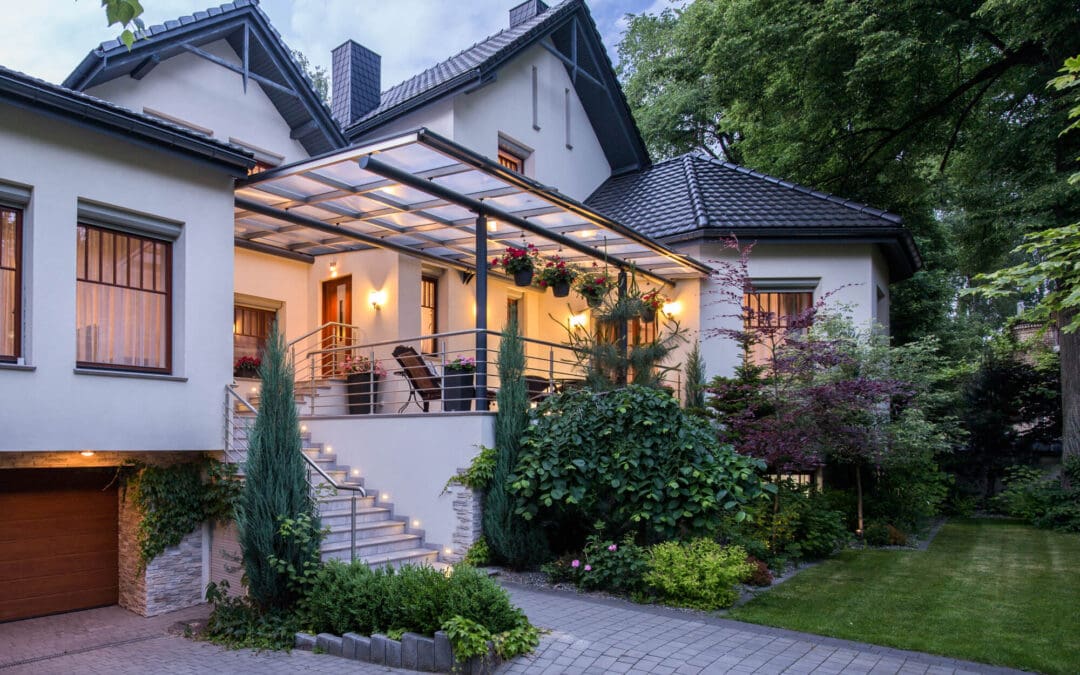
Exterior lighting is one of the most underinvested categories of home improvement. Most homes have minimal outdoor illumination: a porch light that stays on all night, a motion sensor floodlight, and maybe a few solar path lights that emit a faint glow by midnight. This baseline approach leaves significant value on the table in terms of curb appeal, safety, security, and the usability of outdoor spaces after dark. Improving your exterior lighting doesn’t require a major electrical project or a significant budget; it requires an intentional approach to what the light is for, where it goes, and how it connects to create a cohesive result.
Why Exterior Lighting Deserves More Attention
The case for investing in exterior lighting sits at the intersection of four distinct benefits that rarely overlap in other home improvements. Curb appeal, the impression your home makes at night, is directly determined by lighting quality. Safety, the illumination of steps, paths, and entry points, is a daily functional benefit. Security, the deterrent effect of well-lit exteriors on opportunistic intrusion, is a documented benefit that costs very little to achieve. And outdoor livability, the ability to use patios and decks comfortably after dark, extends the functional season of outdoor spaces. Most homes address one or two of these benefits partially and ignore the others. A comprehensive lighting approach addresses all four deliberately, with each light source serving a defined purpose rather than filling space.
Start at the Front: Entry Fixtures and Landscape Lighting
The front of the home is where exterior lighting has the most visible impact on curb appeal, and where most homes have the most opportunity for improvement. A single builder-grade sconce flanking the front door is the minimum most homes have. Flanking the front door with two sconces rather than one creates the balanced, intentional look that single fixtures never achieve. Choosing fixtures with a finish that matches the door hardware and house numbers creates the visual cohesion that distinguishes a considered exterior from an assembled one. Landscape lighting along the front walk illuminates the path from street to door while adding dimensional depth to the facade. Well-placed uplights at the base of significant trees or architectural features create shadow and texture that make the home’s exterior interesting to look at rather than merely visible. Low-voltage landscape lighting systems produce the most dramatic before-and-after results for the investment.
Security, Safety, and Functional Exterior Lighting
Motion-activated security lighting is among the most effective deterrents available and one of the most energy-efficient approaches for areas that need coverage but not continuous illumination. Positioning matters significantly. Security lights that illuminate the approach to entry points, not just the door itself, eliminate concealment at greater distance. Garage access points, side yard passages, and paths between detached structures and the main house all benefit from motion-activated lighting that provides security without consuming electricity continuously. Path and step lighting serve the safety function with a subtlety that security floods don’t, providing the gentle, consistent illumination of elevation changes and stair treads that prevent trips and falls. Integrated step lights, low-profile path lights, and riser-mounted fixtures on outdoor staircases address safety in ways that also look intentional and contribute positively to nighttime curb appeal. Solar-powered lighting has improved considerably in quality, making it practical for path and accent applications where running electrical wiring would be impractical. Current quality solar fixtures maintain adequate charge through most seasonal conditions and provide the consistent low-level illumination that safety-focused exterior lighting requires.
Frequently Asked Questions (FAQs)
How do I plan an exterior lighting design for my home?
Start by walking your property after dark and noting where light is absent and what you need to see in those areas. Identify the front entry approach, elevation changes, patio spaces, garage access, and the property perimeter. Assign each zone a purpose: safety, security, curb appeal, or outdoor living, and select fixture types appropriate to each function. Low-voltage landscape systems, motion-activated security fixtures, and permanent architectural fixtures each serve different roles, and the most effective exterior lighting plans use all three strategically.
What lighting fixtures should I prioritize first?
Entry fixtures flanking the front door are the highest-impact starting point. Motion-activated security lighting at garage and side entry points is the second priority for its security benefit and low ongoing energy cost. Path lighting along the front walk and stairs completes the safety layer. Landscape accent lighting and patio lighting are the final layer that elevates the exterior from functional to designed.
Can I install exterior lighting myself or do I need an electrician?
It depends on the type. Low-voltage landscape lighting systems are designed for DIY installation and run on a transformer that plugs into a standard outdoor outlet. Solar fixtures require no electrical work. Hardwired fixtures replacing existing junction boxes are within DIY capability for homeowners comfortable with basic electrical safety. Adding new circuit runs or installing new junction boxes requires a licensed electrician.
What color temperature is best for exterior light?
For most, 2700K to 3000K produces the warm, inviting quality that makes a home look welcoming from the street and creates comfortable light in outdoor living spaces. Security lighting benefits from slightly cooler 3000K to 4000K for better visibility. Consistency in color temperature across all exterior lighting in a zone creates visual coherence that mismatched temperatures undermine.
How does exterior lighting affect home value and buyer perception?
Well-executed exterior lighting consistently improves buyer perception during evening showings and dramatically improves listing photography, both of which directly affect buyer engagement with the property. Homes with thoughtful exterior lighting appear better maintained, more secure, and more livable.
Homesmith Home Inspections offers Home Inspections in the Houston, Texas, area. Contact us to request our services.